If you’ve ever rested a warm laptop on your thighs during a long work session or relied on a heating pad to soothe back pain, you may have noticed a faint, net-like discoloration lingering on your skin. At first glance, it can look like mild redness, temporary irritation or something that will likely fade on its own. But when that subtle, lace-like pattern sticks around or gradually darkens over time, it may be more than simple heat exposure. This distinctive rash has a medical name: erythema ab igne, also known as toasted skin syndrome.
While it’s typically painless and develops slowly, erythema ab igne is your skin’s way of signaling repeated heat stress. With laptops, heated car seats and at-home heating devices more common than ever, this condition is becoming increasingly recognized in dermatology offices.
To help understand this common skin condition, board-certified dermatologists, Mohs surgeons and cosmetic surgeons, Dr. Joel and Dr. Daniel Schlessinger are sharing their insight on what causes erythema ab igne, whether it’s dangerous and how to treat toasted skin syndrome if it appears. In this blog, we’ll discuss:
- What is erythema ab igne?
- Why does toasted skin syndrome happen?
- Is toasted skin syndrome dangerous?
- Can heating pads cause internal damage?
- What does heat rash from laptop use look like?
- How to get rid of toasted skin syndrome
- Tips for preventing erythema ab igne
What is erythema ab igne?
Erythema ab igne (Latin for “redness from fire”) is a skin condition caused by repeated exposure to low levels of heat. Unlike a burn, the heat isn’t intense enough to cause immediate blistering or pain. Instead, chronic warmth gradually damages superficial blood vessels and pigment cells, leading to a mottled, lace-like pattern of redness or brown discoloration.
Dr. Joel Schlessinger explains, “Erythema ab igne develops when the skin is exposed to a heat source repeatedly over time, even if that heat doesn’t feel extreme. We’re seeing it more often now because laptops, heated car seats and heating pads are used so frequently. I find that it seems to happen in people who fall asleep while on a heating pad, especially if it is on medium or high heat.”
Common causes include:
- Heat rash from laptop use
- Heating pad rash
- Heated blankets
- Heated water bottles
- Space heaters
- Heated car seats
Why does toasted skin syndrome happen?
Your skin contains tiny blood vessels near the surface. When exposed to warmth, those vessels dilate. With repeated exposure, this dilation becomes persistent, and over time the heat can stimulate increased pigment production in the area. The result is a reticulated (net-like) pattern that may start pink or red and gradually turn brown.
“Patients are often surprised because the skin doesn’t hurt the way a burn would,” shares Dr. Daniel Schlessinger. “It’s more of a slow, cumulative heat injury. The pattern is actually a hallmark sign.”
Is toasted skin syndrome dangerous?
In most cases, erythema ab igne is primarily cosmetic and not immediately harmful. However, long-term, repeated heat exposure can lead to permanent pigmentation changes and skin discoloration. There are even very rare cases of skin cancers developing within a patch of erythema ab igne. It’s crucial to see a board-certified dermatologist if you notice any of the following symptoms:
- Persistent discoloration
- Thickening of the skin
- Scaling or a sore that doesn’t heal
Can heating pads cause internal damage?
When used as directed, heating pads typically do not cause internal organ damage. However, the side effects of prolonged heating pad use can include superficial burns, nerve irritation and erythema ab igne. The key risk factor is duration and frequency—not moderate, occasional use. Dr. Joel Schlessinger emphasizes, “Using a heating pad safely, on a low setting and for short intervals, is generally fine. Problems arise when it’s used for hours at a time in the same location.”
What does heat rash from laptop use look like?
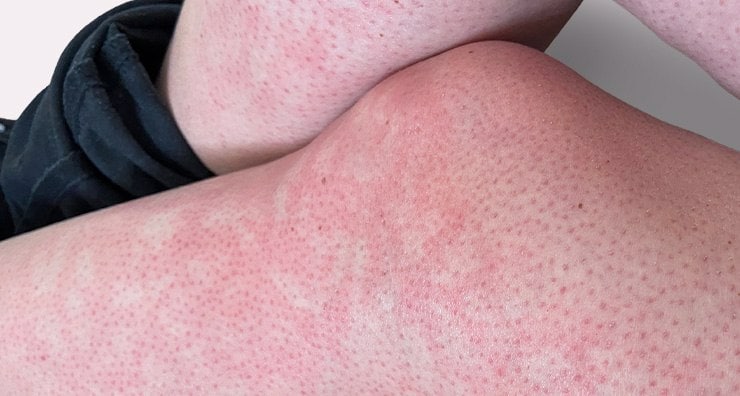
Understanding the visual warning signs of erythema ab igne can help prevent future skin damage. Toasted skin syndrome typically appears on the skin where low to moderate heat exposure has occurred on one or more occasions. Erythema ab igne causes a tell-tale net-like pattern that often appears pink, red or brown. A heat rash from laptop exposure typically appears:
- On one or both thighs
- In a patch the size of your device
- With a faint pink, red or brown net-like pattern
- Without blistering or peeling
How to get rid of toasted skin syndrome
The most important first step when it comes to treating erythema ab igne is simple: remove the heat source. It’s also crucial to see a board-certified dermatologist to determine if any other treatment options are necessary for clearing up any skin discoloration.
“Stopping the exposure is essential,” says Dr. Daniel Schlessinger. “But as with many causes of discoloration, it can take months, if not years, for it to fade. Especially on the lower legs, where blood flow is typically poor, this is not a problem that is going to go away overnight.” Other treatment options may include:
- Topical retinoids to encourage skin turnover
- Skin care products with brightening ingredients to help improve discoloration
- Laser treatments for more persistent pigmentation
- Prescription-strength therapies such as hydroquinone if determined by your dermatologist
Tips for preventing erythema ab igne
When it comes to toasted skin syndrome, even simple adjustments can make a big difference. Creating a barrier between your skin and heat sources helps minimize repeated exposure, which is key to preventing long-term discoloration. Being mindful of how often and how long heat is applied can go a long way in protecting your skin.
“Erythema ab igne is often overlooked because the heat source doesn’t feel intense,” says Dr. Joel Schlessinger, “But with repeated exposure over time, even low levels of heat can lead to persistent skin changes. Prevention really comes down to limiting contact and protecting the skin from chronic warmth.” To prevent erythema ab igne:
- Avoid placing laptops directly on bare skin
- Use a lap desk or barrier
- Limit heating pad use to 15-20 minutes at a time
- Keep heating devices on low settings
- Rotate placement areas
- Wear thicker clothing to reduce heat transfer
If you’re concerned about changes in your skin, scheduling a professional evaluation with a board-certified dermatologist is always the safest next step. As Dr. Daniel Schlessinger notes, “Skin is remarkably resilient, but it does remember repeated stress. The good news is that with early intervention and smart habits, erythema ab igne is usually reversible.”
Looking for more ways to manage common skin concerns? Read our dermatologist-approved tips for managing perioral dermatitis on the LovelySkin blog.
Future-proof your skin: Introducing Skin...
Your best skin care routine for rosacea
Follow us on social
Follow us on social networks and be one of the first to learn about sales, giveaways, and free samples